
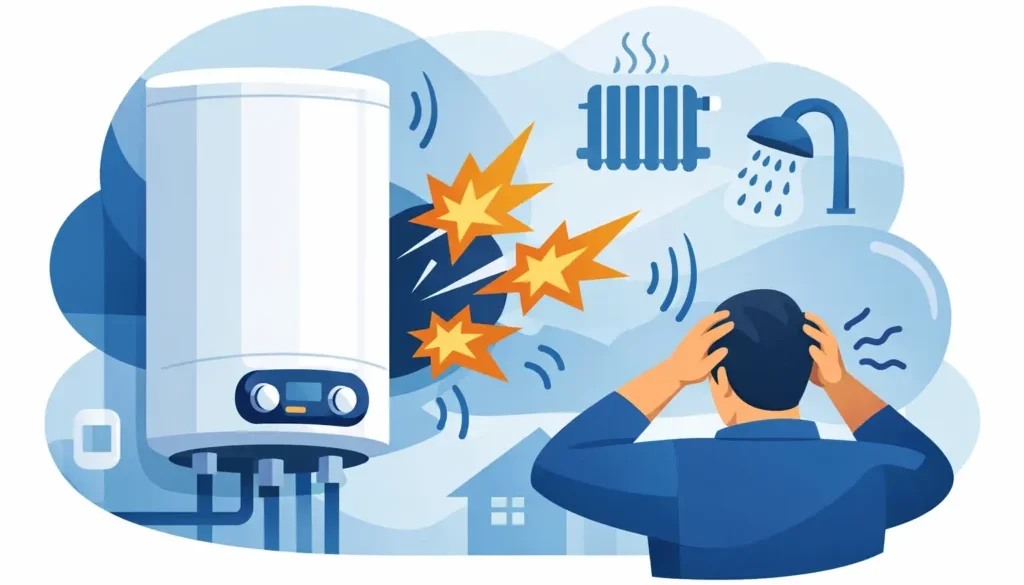
Boiler Making Banging Noises? What It Means
When a boiler starts making a loud bang, clunk or knocking sound, most homeowners think the worst – and understandably so. A boiler making banging noises is not something to ignore, especially if the sound is new, getting worse, or happening alongside poor heating performance, leaks, or pressure issues.
Some boiler noises are relatively minor. Others point to a fault that needs prompt attention. The key is knowing the difference between a harmless expansion noise and a sign that your heating system needs a professional repair.
Why a boiler making banging noises should not be ignored
Boilers are not silent, but they should be predictable. A low hum, the sound of ignition, or a gentle whirr from pumps and fans can all be normal. Sharp banging, kettling, repeated knocking, or loud clunks are different. Those noises usually mean something is restricting water flow, allowing air to build up, or putting strain on internal components.
In practical terms, that can lead to higher energy use, uneven heating, unnecessary wear on the boiler, and in some cases a complete breakdown. If the boiler is also locking out, losing pressure, or failing to heat radiators properly, the noise is often part of a wider problem rather than a one-off quirk.
Common causes of boiler making banging noises
Limescale and sludge build-up
One of the most common causes is a build-up of limescale or sludge inside the heat exchanger or wider heating system. This is often referred to as kettling because the boiler can start sounding like a kettle coming to the boil.
What happens is simple enough. Water cannot circulate as freely as it should, so it overheats in certain spots and turns to steam bubbles before collapsing again. That rapid change can create banging or rumbling noises. This tends to be more common in older systems, hard water areas, and boilers that have gone without regular servicing.
Trapped air in the system
Air can also create knocking, gurgling and banging sounds, especially around radiators and pipework. If the sound seems to travel through the house or happens when the heating first comes on, trapped air is a likely cause.
Air pockets affect circulation and can leave some radiators hot at the bottom but cool at the top. While bleeding a radiator may help in some cases, recurring air in the system can point to a deeper issue, such as pressure imbalance or a component fault.
Water pressure problems
Boilers rely on the correct pressure to work properly. If pressure is too low or unstable, the system may become noisy and less efficient. If it is too high, parts can be placed under extra strain.
Pressure issues do not always cause banging on their own, but they often sit alongside other faults. If your pressure gauge keeps dropping or rising unexpectedly, it is worth having the system checked properly rather than simply topping it up over and over again.
Faulty pump or pump settings
The circulation pump moves hot water around the system. If it starts failing, becomes noisy, or is set incorrectly for the system, it can cause knocking and vibration. In some cases, the sound is less of a bang and more of a drumming or rattling, but homeowners often describe all of it as banging.
A pump issue can also lead to cold radiators, overheating, or hot water problems. This is not usually something to tackle without the right experience, as diagnosis matters. Replacing the wrong part wastes time and money.
Pipes expanding and contracting
Not every bang comes from inside the boiler itself. Sometimes the noise is caused by heating pipes expanding and contracting as they warm up and cool down. If pipes are clipped too tightly, run through joists awkwardly, or sit against floorboards, they can make a sharp knocking sound.
This can be more noticeable in the morning or when the heating first fires up. It is often less serious than an internal boiler fault, but it still needs identifying properly. What sounds like a pipe issue can sometimes turn out to be circulation or temperature control trouble instead.
Boiler components wearing out
As boilers age, parts such as fans, valves, burners and heat exchangers can deteriorate. A worn component may not fail straight away, but it can start making unusual noises long before the boiler stops working altogether.
If your boiler is older and the banging noise has developed gradually, wear and tear may well be part of the picture. In those cases, the right fix depends on the boiler’s age, condition and repair history. Sometimes a straightforward repair is sensible. Sometimes continued repairs start to become poor value.
What you can safely check yourself
If your boiler is making noise, there are a few sensible checks you can make before calling an engineer. Start by noting when the sound happens. Is it only when the heating starts? Only with hot water? Constantly? That information can be very useful when diagnosing the fault.
You can also look at the pressure gauge. Many domestic boilers should sit around 1 to 1.5 bar when cold, though the correct range can vary by system and manufacturer. If the gauge is well below or above normal, that is useful to report.
Check whether all radiators are heating evenly and whether any feel cold at the top. You can also look for obvious leaks around the boiler or beneath radiators. Beyond that, it is best not to interfere. Removing the case, adjusting internal parts, or attempting a gas-related repair is not safe and should only be done by a qualified Gas Safe engineer.
When to turn the boiler off and call an engineer
The noise is sudden, loud, or getting worse
A single small knock from pipework may not be urgent. Repeated banging from the boiler itself is different. If the sound is strong, frequent, or escalating, switch the boiler off and arrange a proper inspection.
You have no heating or hot water
If the noise is accompanied by poor performance, the fault is already affecting the system’s operation. Continued use can make the damage worse.
There is a leak, error code, or pressure loss
Any combination of banging noises with visible water, fault codes, or constant pressure changes needs prompt attention. Those signs usually mean the issue is not superficial.
You smell gas
If you ever smell gas, do not inspect the boiler yourself. Turn off the gas supply if safe to do so, open windows, avoid using electrical switches, and seek urgent professional help immediately.
How an engineer usually fixes the problem
The right repair depends entirely on the cause. If sludge or limescale is restricting circulation, the system may need cleaning, chemical treatment, or in some cases a power flush. If air is the issue, the system may need rebalancing or further investigation into why air keeps entering.
Pump faults may require adjustment or replacement. Pressure problems can involve expansion vessel faults, leaks, filling loop issues, or failing valves. If the noise comes from pipe movement, pipework may need altering or securing more effectively.
This is why proper diagnosis matters. The same “banging” description can point to very different faults. A good engineer will look at the system as a whole rather than guessing from the sound alone.
Can you stop boiler banging noises from coming back?
In many cases, yes. Regular boiler servicing is the best starting point because it helps catch wear, poor combustion, pressure issues and circulation problems before they become bigger repairs. If your system is older, adding inhibitor and keeping the system clean also helps reduce sludge-related issues.
It is also worth paying attention to smaller warning signs. Radiators taking longer to heat up, pressure dropping now and again, or occasional gurgling often appear before louder banging starts. Dealing with those early is usually cheaper than waiting for a full breakdown.
For landlords, routine maintenance matters even more. A noisy boiler in a rental property is not just an inconvenience. It can quickly become a tenant complaint, a heating failure, or a repair that becomes more expensive through delay.
Is it repair or replacement?
It depends on the age of the boiler, the part that has failed, and the overall condition of the system. A relatively modern boiler with a circulation or pressure-related issue is often worth repairing. An older boiler with repeated noise problems, poor efficiency and a history of breakdowns may be better replaced.
There is no one-size-fits-all answer. The cheapest immediate fix is not always the most economical long-term choice, and replacing a boiler too early is not always necessary either. An honest assessment should weigh up safety, reliability, running costs and how often the system has needed attention recently.
If you are in Warrington or the wider North West and your boiler has started making unusual noises, the safest next step is to have it checked by a qualified engineer who can pinpoint the fault properly. A banging boiler rarely fixes itself, but dealt with early, the solution is often more straightforward than people fear.


