Boiler Not Firing Reasons and Safe Checks
A boiler that will not fire can turn a normal morning into a stressful one, particularly when there is no heating or hot water. There are several boiler not firing reasons, from a simple setting or low system pressure to a fault that needs a qualified Gas Safe engineer. A few checks can help identify the likely cause, but never remove the boiler casing or attempt to repair gas components yourself.
First, check whether it is a gas emergency
If you can smell gas, hear a hissing sound near the meter or pipework, or suspect a gas leak, do not try to restart the boiler. Avoid using electrical switches, naked flames or anything that could create a spark. Open doors and windows if it is safe to do so, leave the property, and call the National Gas Emergency Service on 0800 111 999.
A boiler that simply will not ignite is not necessarily a gas emergency, but it should still be treated carefully. Gas appliances need correct combustion, ventilation and safety controls to operate properly. If you are unsure, switching the boiler off and arranging professional help is the sensible choice.
Common boiler not firing reasons
The boiler has no power or the controls are not calling for heat
It sounds obvious, but a boiler cannot fire if it has lost its electrical supply or has not been instructed to heat your home or water. Check that the boiler display is on, the fused spur switch is on, and the relevant circuit breaker has not tripped. If the breaker trips again after being reset, leave it off and have the fault checked.
Then check the thermostat, programmer and any smart heating controls. Set the thermostat above the current room temperature and make sure the programme is set to heating or hot water as required. Flat batteries in a wireless thermostat, an incorrect clock setting, or a recently changed schedule can all stop the boiler receiving a demand.
Low boiler pressure
Most sealed central heating systems need a pressure reading of around 1 to 1.5 bar when cold, although the exact range can vary by boiler manufacturer. If the gauge or display is below the recommended level, the boiler may lock out to protect itself.
Some homeowners can repressurise their system using the filling loop, following the boiler manual carefully. Do not overfill it. Once the system is cold, pressure that is much above the recommended range can also cause problems and may lead to water discharging outside through the pressure relief pipe.
If the pressure regularly drops, topping it up is only a temporary measure. There may be a leak on the heating system, an issue with a radiator valve, or a fault inside the boiler. Repeated pressure loss should be investigated rather than ignored.
A fault code or boiler lockout
Modern boilers display a fault code when they detect a problem. The code may relate to ignition, flame detection, pressure, overheating, fan operation or the condensate system. Write down the code, along with the boiler make and model, before doing anything else. This gives an engineer a useful starting point.
Many boilers have a reset button, and one reset may be appropriate if the manufacturer’s instructions say so. If it locks out again, do not keep resetting it. Repeated lockouts usually indicate an underlying fault, and persistent resets can delay a proper repair.
Frozen or blocked condensate pipe
Condensing boilers produce water during normal operation, which drains away through a condensate pipe. In cold weather, an external condensate pipe can freeze. The boiler may then stop firing or display a related fault code because it cannot drain safely.
If the pipe is accessible and you are confident it is frozen, it can often be thawed gently with warm water – never boiling water – poured over the outside of the pipe. Use a hot water bottle if that is safer. Once thawed, reset the boiler once in line with its instructions.
If the pipe is not clearly accessible, is leaking, or the boiler still will not fire, arrange an engineer visit. A correctly installed condensate route and suitable insulation can reduce the chance of the same problem returning during the next cold spell.
The gas supply has been interrupted
Check whether other gas appliances, such as a gas hob, are working. If they are not, there may be an issue with the gas supply, prepayment meter credit, emergency control valve or meter. Do not use a naked flame to test anything.
For prepayment meters, make sure there is credit available and that any necessary emergency credit has been activated. If you have recently moved in, had meter work carried out, or experienced a supply interruption, the gas supply may need attention before the boiler can operate.
If other gas appliances work but the boiler does not, the fault is more likely to be within the boiler or its controls. That requires a Gas Safe registered engineer.
Ignition, flame sensor or internal component faults
When a boiler attempts to start, it runs a series of safety checks before ignition. Problems with the ignition electrode, flame sensor, fan, pump, gas valve, printed circuit board or safety devices can stop that process. You may hear the boiler clicking, whirring or attempting to start before it locks out.
These parts are not homeowner repairs. The boiler case is part of the appliance’s safety system, and work inside it must be carried out by a suitably qualified Gas Safe engineer. The correct repair depends on testing, not guesswork, which helps avoid replacing parts unnecessarily.
A frozen heating system or circulation problem
During very cold weather, a condensate pipe is not the only part of the system affected. Frozen external pipework, a stuck pump, air in the system or a closed valve can prevent water circulating correctly. The boiler may overheat, show an error code or shut down as a safety precaution.
Look for obvious signs such as leaking water, cold radiators, unusual banging noises or a boiler that becomes noisy before cutting out. Do not attempt to drain down or dismantle the system unless you are trained to do so. Water damage can be costly, and the original issue may still remain.
Safe checks before booking a repair
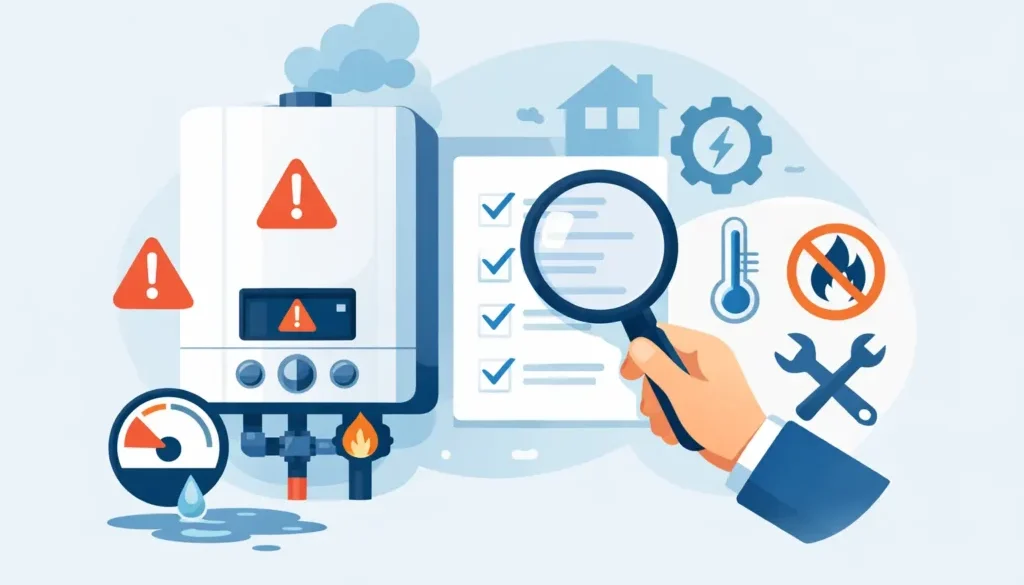
Before arranging a visit, it is useful to note whether you have lost heating, hot water, or both. Check the pressure reading, thermostat setting, fault code and whether other gas appliances are working. If your boiler has recently been serviced, mention this too, along with any changes such as a power cut, freezing weather or work on the gas meter.
Keep the boiler area clear and make sure an engineer can access the appliance, controls and any visible external condensate pipe. These simple details can help diagnose the fault more quickly and keep the visit focused on the repair.
Avoid taking chances with the following:
- Do not remove the boiler cover or interfere with gas pipework.
- Do not repeatedly reset a boiler that keeps locking out.
- Do not use boiling water, a blowtorch or an exposed heater to thaw pipes.
- Do not ignore a yellow or lazy flame on another gas appliance, soot marks, or symptoms of carbon monoxide such as headaches, dizziness or nausea.
If you suspect carbon monoxide, get everyone into fresh air, seek urgent medical advice where needed, and have the appliance checked before using it again. A working audible carbon monoxide alarm near gas appliances provides an essential extra warning, but it does not replace correct installation and servicing.
When a repair is the right call
A boiler can fail to fire for a minor reason, but the difference between a straightforward reset and a genuine fault is not always visible from the outside. Call a qualified engineer if the boiler has a recurring fault code, loses pressure, leaks, makes unusual noises, has no gas supply to the appliance, or will not restart after the basic checks above.
For landlords, a non-firing boiler can also affect your responsibilities to tenants, particularly where heating, hot water or gas safety is concerned. Keep records of repairs and servicing, and make sure gas safety checks are completed by a Gas Safe registered engineer.
Regular annual servicing is one of the best ways to reduce unexpected boiler faults. It cannot prevent every breakdown, especially as components age, but it can identify wear, poor combustion, pressure issues and condensate problems before they leave you without heat. If your boiler is not firing, a calm set of safe checks followed by the right professional support is the quickest route back to a warm, comfortable home.